Google

green econometrics

Information and analysis on the economics of solar and alternative energies

green econometrics header image 2

Understanding the Cost of Solar Energy

August 13th, 2007 · 17 Comments

In comparison to conventional hydrocarbon fuels such as coal or oil in generating electricity, the cost of solar energy is significantly higher. To compare energy cost, a common equivalent is required. Back in our previous post, Coal: Fueling the American Industrial Revolution to Today’s Electric, we developed a framework to measure energy costs by converting costs to kilowatt-hours (KWH).

In our example, a ton of coal on the average produces approximately 6,182 KWH of electric at a cost of about $36 per short ton (2,000 pounds). Under this measure coal cost less than$0.01 per KWH. In comparison, a barrel of oil at $70/barrel produces 1,700 KWH at a cost approximately $0.05 per KWH. Let’s provide some measures to understand energy costs.
Energy Units and Conversions KEEP

Energy Comparison
1 ton of coal = 6,182 KWH
1 barrel of oil = 1,699 KWH
1 cubic foot of gas = 0.3 KWH

Energy Costs
1 ton of coal costs $36 = $0.006 per KWH
1 barrel of oil costs $70 = $0.05 per KWH
1 cubic foot of gas $0.008 = $0.03 per KWH

In comparison to solar energy, the hydrocarbon fuel costs are significantly lower without rebates, tax benefits nor the cost of carbon emissions. A two–Kilowatt (KW) solar energy system costs about $45,000 and covers roughly half of a typical American household’s energy needs. At $45,000, a solar energy system equates to $9,000 a kilowatt. The $9,000 per KW for solar is not very helpful in comparing electric generation costs to other fuels like coal or gas. Since coal, oil, and gas can be measured on a cost per KWH, we should measure solar costs on a KWH basis.

Some of the considerations for a solar energy system include the 20-to-30 year lifespan of the system and the hours of available sunlight. The hours of available sunlight depends on latitude, climate, unblocked exposure to the sun, ability to tilt panels towards the sun, seasonality, and temperature. On the average, approximately 3.6 peak sunlight hours per day serves as a reasonable proxy to calculate the average annual output of electric from solar energy panels.

Solar Energy Costs
Average system costs = $95 per square foot
Average solar panel output = 10.6 watts per square foot
Average solar energy system costs = $8.95 per watt

In order to compare the solar energy costs to conventional hydrocarbon fuels, we must covert the $8.95 per into KWH. Let’s make two calculations to measure the total electric energy output over the lifespan of the solar energy system. The first adjustment is to convert solar direct-current (DC) power to alternating current (AC) power that can be used for household appliances. The conversion of DC to AC power results in an energy loss of 10 percent for a solar energy system. The second calculation is to approximate total electric output by multiplying the average peak hours of sunlight (about 3.63 hours per day) times 365 days times 20 years (the product lifespan).

For our 5-KW solar energy system costing $45,000, the conversion to KWH is as follows:

5 KW times 90% = 4.5 KW - (Conversion of DC to AC power)
4.5 KW times 3.63 hours = 16 KWH per Day
16 KWH x 365 = 5,962 KWH - (Average Annual Output)
5,962 KWH x 20 years = 119,246 KWH – (Total output over 20 year lifespan)

So a $45,000 5KW solar energy system produces about 119,246 KWH of electric over its lifespan meaning the average cost equals $0.38 per KWH. ($45,000 divided by 119,246 KWH)

Figure 1 Cost of Energy
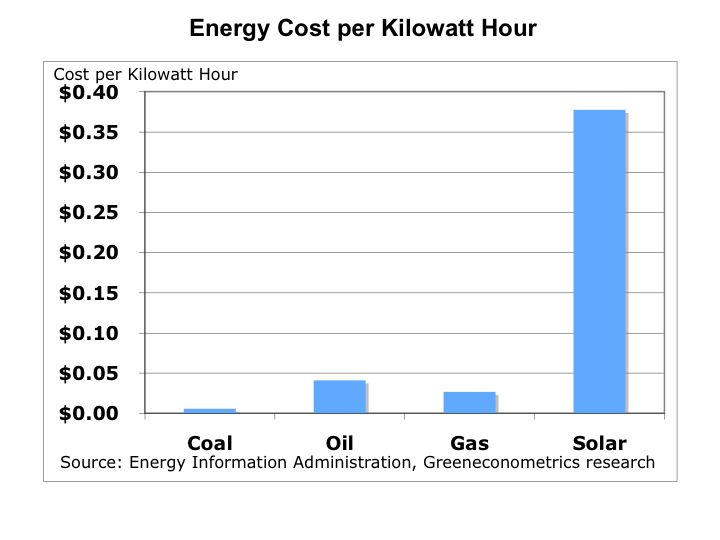
Energy Costs

The relatively high solar energy costs in comparison to conventional fuels should improve with utility rebates and government tax incentives. In addition, solar panel prices should continue to decline as volume production increases. Solar cell manufacturers employ similar production methods as semiconductor suppliers and benefit from economies of scale.

There are several components of a solar energy system. Solarbuzz provides some detailed information on solar industry pricing. Solarbuzz
The single largest cost is the solar panels themselves. The following figure provides an overview of the components of a solar energy system. Sharp Solar provides a very useful calculator for system costs and electric generation by geographical location along with utility rebates for your area. Sharp Solar Energy

Figure 2 Solar Energy Component Costs
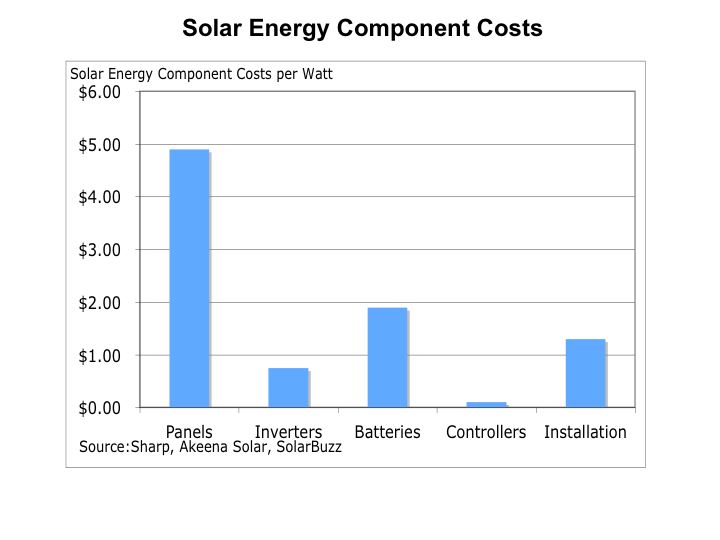
Component Costs

We will explore the some of the advances in thin-film technologies, the declining costs of solar panels, and the improving solar conversion efficiencies that should continue to bring solar energy costs on par with hydrocarbon fuels. With the improving cost structure of solar and a better understanding of the cost of carbon emissions from hydrocarbon fuels, we may find a more level playing field in comparing energy costs.

Tags: Alternative Energy · Energy Economics · Home Energy Economics · Solar Energy

17 responses so far ↓

  • 1 Solar Energy: The Security Perspective // Sep 12, 2007 at 12:43 am

    [...] and costs, we found solar energy cost approximately $0.38-to-$0.53 per Kilowatt-Hour (KWH). See Understanding the Cost of Solar Energy There is considerable variance in the cost of solar energy because sunlight availability varies by [...]

  • 2 Solar Energy Parity // Sep 13, 2007 at 11:00 am

    [...] Green Econometrics’ research estimates that solar energy cost about $0.38-to-$0.53 per KWH. (See Understanding the Cost of Solar Energy ) There are two significant market factors that should help reduce the cost of solar energy: strong [...]

  • 3 Scott D. Strader // Oct 19, 2007 at 5:17 pm

    The $0.38 per KWH represents what the economic cost of the consumer’s use is. I’m curious what the energy cost of society’s production is. Would it be measured in % KWH/KWH? This would give us the efficiency of the production of each energy source.

    I’ve searched elsewhere but haven’t found a reference. Is this even a valid measurement?

  • 4 Jason Robinson // Nov 20, 2007 at 2:09 pm

    Fascinating information.

  • 5 Doodee // Feb 2, 2008 at 12:48 pm

    Thanks for sharing

  • 6 Sheeldvef // Feb 9, 2008 at 8:45 pm

    I’d prefer reading in my native language, because my knowledge of your languange is no so well. But it was interesting! Look for some my links:

  • 7 altenergyfan // Feb 15, 2008 at 5:25 am

    For what year is figure 1 referring to?

    Figure 1 is for 2004.

  • 8 Engr.M.Saiful Islam // Mar 21, 2008 at 10:55 am

    Solar energy cost be spread over the solar panel lifetime and investment in solar panel would free the consumers from worrying about fossil fuel cost and shortage.

  • 9 Sheeldvef // Mar 24, 2008 at 5:53 am

    I’d prefer reading in my native language, because my knowledge of your languange is no so well.

  • 10 Robert // Apr 19, 2008 at 9:13 pm

    You listed the oil cost at $70 per barrell when it is actually at around $112 a barrell right now. So it is quite a bit more expensive than what you list.

  • 11 Bruce // Jul 1, 2008 at 4:51 pm

    I get the idea. Still you neglected the cost of the capital required to purchase and install the system. There are corresponding costs for fossil fuels, but I suspect they are much cheaper.

    For example, at 5% interest, there would be a monthly payment of about $297 for a total of about $71000.

  • 12 Matthew // Oct 10, 2008 at 5:03 am

    It seems you compared the fuel cost for fossil fueled generation with the equipment cost for PV. Isn’t that a mistake? A meaningful comparison would be total cost to total cost. Coal not will turn itself into electricity without a power plant. Since you included the DC/AC conversion losses for PV then you should also include the transmission losses from the central power plant to the user.

  • 13 rvman // Oct 21, 2008 at 7:56 pm

    Besides the capital cost issue above, you appear not to be taking thermal efficiency into account - a good gas-fired generation plant converts about 50% of the gas into energy, while a good coal plant may run about 33%. That puts coal costs about 1.8 cents per kWh, and gas at about 6 cents per kwh.

    Fuel isn’t the only cost though - if that were true, nukes rule at 0.5-0.8 cents in fuel costs per kWh or 2-3 cents per kwh for a new plant . (Older nuclear plants were ’boutique’ built with a different design for each plant, while new, more efficient plants can be built from standard designs at much lower cost - about $1500/kw, which works out to about 2 cents per kwh for 30 year life including carrying costs, but excluding the 0.5-0.8 cents per kwh for fuel.)

    For a greener alternative, wind is 10-12 cents per kwh. (obviously, based on capital costs, since the ‘fuel’, i.e. wind, is free for the taking) It beats solar hands-down, and is competitive with gas when gas is over $10.

  • 14 Nadeem // Oct 26, 2008 at 3:19 pm

    Is it possible to compare the cost of solar energy and hydrocarbon fuels’ generated energy without considering the time valu of money as well as the increasing rate of fuel price?. When we take the avarage value of solar energy then we should also calculate the other energy on the basis of twent years. Because cost of inputs (fuel) will not remain same ever.

    Thanks for sharing this useful information.

  • 15 Natiy // Nov 27, 2008 at 8:47 am

    Let me ask you a link where can I find solar panels and their costs thanks

  • 16 John Paul // Feb 15, 2009 at 9:20 pm

    Bruce (4:51pm) - The amortization of the cost of the capital expenditure is precisely what the author did. The entire point is prefaced by the cost of the solar power system spread over time, just like a functionally analogous loan repayment schedule.
    Matthew (5:03am) - Yes and No. The author’s comparison is valid, though somewhat simplistic. The total cost of the energy, either from solar power or from any other source, can be viewed in two ways. The cost could be understood in terms of net present cost, that is, as a lump sum of money today, or you can understand it as a series of payments over time, just like the classic winning the lottery decision (ie, lump sum up front or monthly payments over time?) The two figures can be logically compared.
    As far as energy is concerned, solar is a lump sum and paying utilities is a recurring cost. The author just figured that $10000 today is like $1000 per year for ten years. As Nadeem pointed out, that isn’t true, but the logic is in the right direction. The author didn’t complete the math. Payments over time are by nature less painful than payments up front. So to be accurate, some assumptions should be made, disclosed, and accounted for in the math. For example, paying $10k up front is less desirable than paying $100 per month for 100 months. It’s the same amount of money, but there are other costs going on. You might not have $10ooo, so you have to figure in borrowing costs to get your paws on the money. What about the price of fossil fuels? Are we to assume they are static, or are they rising or falling in relation to the overall inflation rate? You could make a reasonable argument that fossil fuels will increase in price faster than overall inflation, since it seems like rising demand and political considerations in the future are likely to inflate the cost of CO2 producing fuels faster than other prices. There are yet more meaningful factors, too, as mentioned by some above posters, like risk. Businesses like the idea of knowing for sure what their bills will be in the future. Knowing that lets them know more precisely how much cash they will have to play with at any given time in the future. These are big considerations when you’re juggling whole factories, offices, and the salaries of an army of employees. A solar investment is reliable, while the price of fossil fuel power goes up and down (and usually up, it seems). You can see how these various factors get very complicated! THAT SAID, the other factor you mention that you think should be included in the analysis (transmission line loss) is in fact included, along with all the other sundry inefficiencies of fossil fuel power, in the kilowatt hour charge. The utility bases their fees on their total cost of running their power company - lines, plants, inefficiencies, and all.
    rvman (7:56pm) - See the end of the above answer - energy conversion efficiency is not relevant to the cost discussion. You are not billed according to how many kilowatt hours the plant makes for you. You are billed for what you get piped into your house, post efficiency losses. Of course, efficiency of the fossil fuel source matters for determining tons of CO2 emitted and of course, an efficient fossil fuel plant is better than an inefficient one.
    Nadeem (3:19pm) - Exactly.

  • 17 David // Jun 15, 2009 at 4:14 pm

    Rod Adams points out that the cost of fuel for a Light Water Reactor LWR (including fabrication, enrichment, storage, disposal) is about 0.47 cents per KWH. The total O&M cost for LWR power is about 1.7 cents per kilowatt hour.

    This emission free source of power is also not as subject to price variables since the cost of fuel itself is such a small part of the cost of generation.

    B&W have proposed a LWR that uses passively safe cooling and can be constructed on a modular basis in 125 MW units.

Leave a Comment

Check Box